













Retail Business Intelligence
Boost your business with retail business intelligence solutions that turn data into smarter decisions. Algoscale helps retailers leverage business intelligence in the retail industry through scalable retail BI platforms, analytics, and reporting by enabling better demand forecasting, inventory optimization, and customer insights across the retail value chain.
Algoscale is trusted and loved by –


What is Retail Business Intelligence
Retail business intelligence refers to the use of data analytics, reporting, and visualization to understand and improve retail performance. It combines data from multiple sources such as POS systems, inventory systems, eCommerce platforms, and customer data to provide meaningful insights for retailers.
- Business intelligence in the retail industry helps organizations:
Analyze sales trends, customer behavior, inventory levels, pricing performance, and supply chain efficiency. - Create real time dashboards and retail business intelligence reports with the right retail business intelligence software to support faster and smarter decision making.
- Forecast demand, reduce stockouts, optimize promotions, and personalize customer experiences. As a result, business intelligence for retail industry plays a critical role in driving growth, improving margins, and staying ahead of the competition in this retail sector.
Advanced Analytics and Essential Features For Retail Business Intelligence Solutions.
Advanced analytics is a core part of business intelligence in the retail industry, helping retailers understand customers, optimize operations, and improve profitability. Algoscale offers you a complete set of analytics and solutions that are commonly provided to the clients we work with
Analyze customer behavior, preferences, and buying patterns using retail business intelligence to improve personalization, loyalty and retention.
Gain visibility into supplier performance, lead times, and costs using business intelligence for retail industry, to strengthen vendor relationships and reduce risks.
Track sales performance across stores, regions, and channels with retail business intelligence reports that identify trends, opportunities, and gaps.
Algoscale uses business intelligence in retail sector to understand market trends, competitor performance, and regional demand patterns.
Monitor foot traffic, conversion rates, and in store behavior using retail business software to optimize store layouts and staffing.
Analyze product performance, category trends, and assortment effectiveness using retail industry business intelligence to improve merchandising decisions.
Integrate ecommerce and digital data into your retail business intelligence platform to track online customer journeys, conversions, and campaign performance.
Integrations for Retail Business Intelligence.
Effective retail business intelligence depends on seamless integration with multiple retail systems to deliver accurate, real time insights. A well connected retail business intelligence platform brings together data from across the retail ecosystem, enabling smarter decision across operations, sales, and customer engagement,
Integrating POS systems with business intelligence in retail helps retailers track real time sales performance, transaction trends, and store level metrics. This data powers accurate retail business intelligence reports for daily and strategic decision making.
Retail BI integrations with inventory management and supply chain tools provide visibility into stock levels, replenishment cycles, and supplier performance. These integrations support business intelligence for retail by reducing stockouts and improving product availability.
Connecting ERP and accounting systems enables financial transparency across stores and channels. This integration strengthens retail industry business intelligence by aligning sales, costs, margins, and profitability insights.
CRM integrations enhance business intelligence in retail sector by combining customer data with sales and marketing insights. Retailers can analyze purchasing behavior, loyalty trends, and campaign effectiveness using retail business intelligence software.
Integrating ecommerce platforms ensures unified insights across online and offline channels. This supports business analytics and business intelligence solutions in retail, helping retailers understand customer journeys and omnichannel performance.
Retail BI integrations with marketing platforms enable analysis of promotions, discounts, and campaign ROI. These insights help retailers optimize pricing and promotional strategies using business intelligence software for retail.
BI Use Cases in Retail.
Retail business intelligence enables retailers to turn data into actionable insights across sales, supply chain, marketing, and store operations. Here are some of the most impactful business intelligence use cases in the retail industry.
Sales intelligence uses retail business intelligence reports to track revenue trends, product performance, and seasonal demand. By analyzing historical and real time sales data, retailers can forecast demand accurately and improve decision making across channels.
With business intelligence in retail, supply chain intelligence helps monitor inventory movement, supplier performance, and logistics efficiency. Retailers can reduce delays, optimize replenishment cycles, and improve coordination across warehouses and stores.
This leverages geographic and store level data to evaluate store performance, foot traffic, and regional demand. Using a retail business intelligence platform, retailers can identify high performing locations and plan store expansion strategies.
Retailers use business intelligence for retail to measure the effectiveness of campaigns, better customer segmentation, and improved ROI through data driven insights.
With retail businesses intelligence software, businesses can compare pricing assortment,and performance metrics against competitors. This helps retailers stay competitive,optimize pricing strategies and respond quickly to market changes.
Our Retail Business Intelligence Services
Algoscale delivers end-to-end retail business intelligence services that help retailers turn raw data into actionable insights. Our solutions are designed to support smarter decisions across merchandising, inventory, finance, and customer experience using modern retail business intelligence platforms.
Retail BI Implementation Consulting
Our retail business intelligence consulting services help retailers define the right BI strategy, select suitable retail BI software, and plan a scalable architecture aligned with business goals across the retail value chain.
Retail BI Strategy
We provide full retail BI implementation and strategy, integrating data from POS, ERP, CRM and eCommerce systems into a unified retail business intelligence platform for accurate reporting and analytics.
Retail Data Analysis & Reporting
Gain deeper visibility into sales performance, customer behavior, and store operations through advanced retail business intelligence reports that support faster, data driven decisions across the retail organization.
Custom Dashboards & Data Visualization
We design intuitive dashboards using leading business intelligence software for retail, enabling teams to track KPIs, monitor trends, and explore insights with ease across departments.
Retail Data Security & Governance
Our retail business intelligence solutions include enterprise grade data security, access controls, and governance frameworks to ensure compliance, accuracy, and trusted reporting.
Retail Accounting Software
Algoscale integrates retail accounting software with BI platforms to deliver clear insights into margins, profitability, cost structures, and financial performance across stores and channels.
Inventory Management & Optimization
Our business intelligence for retail solutions help optimize inventory levels, reduce stockouts, and minimize overstock by combining demand forecasting with real time inventory analytics.
Essential Metrics for Retail Business Intelligence.
To make the most of retail business intelligence, retailers need to track the right metrics that connect data to real business outcomes. These metrics help organizations using business intelligence in the retail industry improve decision making across sales, inventory, marketing and operations.
Sales related metrics such as total revenue, sales growth, average order value, and conversion rates are core to retail industry business intelligence. These insights allow retailers to analyze trends, compare store or channel performance, and generate accurate retail business intelligence reports.
Metrics like inventory turnover, stockout rate, sell through rate, and days of inventory on hand are critical for business intelligence for retail. They help retailers reduce overstocking, prevent stockouts, and improve inventory optimization using retail business intelligence platforms.
Customer centric metrics include customer lifetime value (CLV), repeat purchase rate, basket size and churn rate. With business intelligence in retail, these metrics provide deeper insights into shopping behavior and support personalized marketing strategies.
Gross margin, discount impact, markdown effectiveness, and price elasticity are essential for better pricing decisions. Retail business intelligence software enables retailers to balance profitability with competitiveness through data driven pricing strategies.
Metrics such as campaign ROI, customer acquisition cost, and promotion effectiveness help retailers measure the success of marketing initiatives. These insights support business analytics and business intelligence solutions in retail by aligning marketing spend with measurable outcomes.
Footfall, sales per square foot, online vs offline performance, and omnichannel conversion rates are key indicators in business intelligence in the retail sector. These metrics help retailers optimize store layouts, staffing, and digital channels.
Transformations We’ve Delivered.
From ambitious startups to global enterprises — here’s how our clients turned strategy into scalable tech with Algoscale.
Result:
Result:
Result:
Results That Algoscale’s Clients Achieve.
faster decision making with centralized dashboards, automated reporting, and real time KPIs across departments.
reduction in your operational costs through BI automation, optimized data workflows, and improved resource allocation.
improvement in data accuracy & reliability with governed data models, validated pipelines, and enterprise grade BI frameworks.
increase in reporting speed after migrating to modern BI platforms like Power BI, Tableau, Looker, and Snowflake.
improvement in team productivity by eliminating manual spreadsheets and enabling self service analytics.
dashboard availability supported by robust data infrastructure, simplified maintenance, and scalable architectures.
Types of Retail Business Intelligence.
Modern retail business intelligence combines different types of analytics to help retailers understand what is happening in their business, why it is happening and what actions are needed to be taken next. These analytics form the foundation of effective business intelligence in the retail industry.

Descriptive analytics focuses on understanding past and current performance. It uses historical data to generate retail business intelligence reports such as sales summaries, revenue trends, inventory levels, and store performance. This type of business intelligence in retail industry gets a clear picture of “what happened”.

Diagnostic analytics goes a step further by explaining why something happened. By analyzing patterns and relationships in data, retail industry business intelligence helps retailers identify reasons behind sales drops, stockouts, or declining customer engagement. It is essential for improving operational decisions in the retail sector.

Predictive analytics uses historical data and statistical models to forecast future outcomes. With retail business intelligence software, retailers can predict customer demand, sales trends, and inventory requirements. This enables proactive decision making and supports smarter planning across stores and channels.
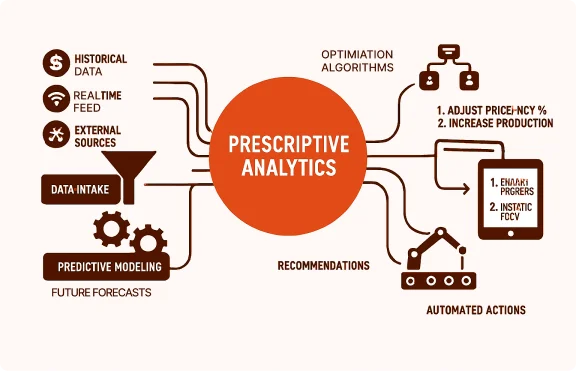
Prescriptive analytics recommends the best actions to take based on insights and predictions. Using advanced business intelligence for retail, retailers can optimize pricing, promotions, inventory allocation, and supply chain strategies. This type of analytics helps businesses stay ahead in the retail business intelligence platform ecosystem.
Top BI Platforms for the Retail Sector.
Choosing the right BI platform is critical for building a scalable and high performing retail business intelligence platform. Modern business intelligence software for retail helps retailers analyze sales, inventory, customer behavior, and market trends in real time. Below are some of the most widely used BI platforms for our clients in the retail industry
Microsoft Power BI
This tool is a popular choice for retail business intelligence due to its ease of use, strong visualization capabilities, and seamless integration with Microsoft tools. Retailers use Power BI to create interactive retail business intelligence reports, monitor KPIs, and gain insights into sales and inventory performance.
Tableau
Tableau is widely adopted for advanced business intelligence in retail industry use cases. It enables deep data exploration, visual storytelling, and self service analytics, making it ideal for analyzing customer behavior, merchandising performance and store level insights.
Qlik
Qlik supports associative analytics that allow retailers to explore data freely across multiple dimensions. It is commonly used in retail industry business intelligence for demand forecasting, supplier analytics, and identifying hidden trends across sales and inventory data.
Amazon Redshift
Amazon Redshift is a powerful cloud data warehouse often used as the backbone of retail business intelligence software. It supports large scale data processing and enables retailers to run complex analytics across transaction, customer, and supply chain data.
Looker
Looker provides modern, model driven analytics that support consistent metrics across teams. Retailers use Looker for embedded analytics, real time dashboards, and scalable business intelligence for retail industry use cases across eCommerce and physical stores.
Azure Synapse Analytics
Azure Synapse Analytics combines data warehousing and big data analytics, making it ideal for enterprise scale retail business intelligence platforms. It helps retailers unify data from multiple sources and power advanced business intelligence solutions in retail.
Our Approach to Retail Business Intelligence.
At Algoscale, we follow a structured and practical approach to deliver scalable retail business intelligence solutions that help retailers turn data into measurable business outcomes. Our process ensures your retail business intelligence platform is aligned with business goals, operational needs, and customer expectations.
We begin by understanding your retail business model, data landscape, and challenges across sales, inventory, marketing, and operations. Our retail business intelligence consulting experts align BI objectives with your business goals to define clear success metrics.
Our team designs a robust retail business intelligence architecture, integrating data from POS systems, inventory platforms, eCommerce, CRM, and supply chain systems.
We develop retail business intelligence reports, custom dashboards, and analytics models to deliver actionable insights. Early validation ensures data accuracy, usability, and relevance for real world retail decision making.
Once deployed, we continuously optimize your retail business intelligence software for performance, scalability, and evolving business needs. Our focus is long term value, enabling smarter decisions across merchandising, pricing, inventory,and customer engagement.
How Much Does Retail Business Intelligence Implementation Cost.
The cost of implementing retail business intelligence depends on your organization’s size, complexity of data sources, and the depth of analytics required. From basic dashboards to advanced retail BI platforms, here is a practical view of costs across the below levels:
For smaller retail businesses or early stage business intelligence in retail industry initiatives, a basic solution typically includes foundational reporting, essential dashboards, and integration with a few key systems such as POS and CRM.
This tier enables standard retail business intelligence reports and basic insights into sales and customer behavior.
Estimated Cost : US $15,000- $35,000
Large retail enterprises with extensive integrations, complex analytics and multi department reporting require sophisticated retail business intelligence solutions.
This investment supports comprehensive business analytics and business intelligence solutions in retail, including advanced visualization, predictive insights, and enterprise wide visibility..
Estimated Cost : US $70,000+
Mid complexity projects usually involve more data sources, enhanced integration, more advanced dashboards, and real time analytics capabilities.
At this level, you gain deeper business intelligence in retail, improved forecasting, and better decision support across departments.
Estimated Cost : US $35,000- $70,000
Proof Over Promises.
Our clients speak for us. These testimonials showcase the trust we’ve earned and the results we’ve delivered, time and again.
Benefits of Retail Business Intelligence.
Retail business intelligence helps retailers turn raw data into meaningful insights that improve both customer experience and business performance. By using business intelligence in the retail industry, organizations can respond faster to market changes and make smarter decisions across the retail operations.
With business intelligence for retail, retailers gain a deeper understanding of customer behavior, preferences, and buying patterns. This allows brands to personalize offers, improve in store and online experiences, and build long term customer loyalty using data driven insights.
Retail business intelligence platforms enable retailers to analyze customer segments and campaign performance. By leveraging retail business intelligence reports, marketing teams can run more targeted promotions, reduce wasted spend and improve conversion rates.
Using business intelligence in the retail sector gives retailers real time visibility into sales trends, market performance, and competitor behavior. This helps businesses stay ahead of making informed, proactive decisions instead of reacting too late.
With accurate forecasting powered by retail industry business intelligence, retailers can anticipate demand more effectively. This reduces stockouts, avoids overstocking, and ensures the right products are available at the right time.
Retail business intelligence software helps retailers optimize product distribution across stores and regions. By analyzing sales velocity and location based demand, businesses can allocate inventory more efficiently and improve overall sales performance.
Using business analytics and business intelligence solutions in retail, retailers can evaluate pricing trends, discounts, and margins. This enables smarter pricing strategies that balances competitiveness with profitability.
Why Choose Algoscale as a Retail BI Service Provider.
Algoscale helps retailers turn data into profitable decisions with scalable retail business intelligence solutions. Our expertise across business intelligence in the retail industry enables brands to gain real time visibility into sales, inventory, customers, and operations.
We understand the complexities of retail sector, from omnichannel sales to inventory planning and demand forecasting. Our experience in retail industry business intelligence ensures insights that are practical, actionable and aligned with retail KPIs.
We help retailers streamline reporting, automate insights, and reduce manual data efforts through efficient business intelligence for retail. This leads to faster decisions, optimized stock levels, and improved operational performance.

Our team, as a trusted data consulting firm, delivers robust retail business intelligence platforms using modern BI tools and cloud analytics. We design scalable solutions that support advanced reporting, predictive analytics, and data-driven decision-making across the organization.
Our retail business intelligence software solutions are built with security, scalability, and performance in mind by supporting growth across stores, regions, and digital channels without compromising data integrity.
Technologies We Use.
Algoscale uses a modern, secure, and scalable technology stack to deliver reliable Retail Business Intelligence solutions.
Cloud Platforms
Data Warehousing & Lakehouse
Databases (SQL & NoSQL)
ETL / ELT & Data Integration
Big Data & Processing Frameworks
Business Intelligence & Visualization
Data Science, ML & AI
DevOps & Automation
Explore Our Latest Insights.
Stay ahead with expert perspectives, industry trends, and practical advice from Algoscale’s team. Our blogs are designed to help business leaders, data teams, and innovators turn complexity into clarity.
As data-driven decision-making continues to shape enterprise strategy in 2026, businesses are actively seeking top Tableau consultants to unlock deeper
Businesses today generate massive amounts of data, but much of it remains underutilized. In fact, studies suggest that up to
Data volume is no longer the problem. The real challenge for modern enterprises is turning fragmented data into structured, decision-ready
Get Started with Us.
Algoscale follows a structured and scalable approach to deliver retail business intelligence solutions that help organizations improve visibility, optimize operations, and make data driven decisions across the retail industry business intelligence landscape.
Get in touch through our secure contact form, protected by NDA, and speak with our specialists to understand your challenges in business intelligence in retail, reporting requirements, and data goals across sales, inventory, and customer analytics.
Frequently asked questions.
We’ve answered the most common ones to help you understand our approach, our capabilities and how our team of experts can support your business goals
1. What is Retail Business Intelligence?
Retail business intelligence is the use of data, analytics, and reporting tools to help retailers understand sales, customers, inventory, and operations for better decision making.
2. How does business intelligence help the retail industry?
Business intelligence in retail industry helps improve customer experience, optimize inventory, reduce stockouts, and enable data driven pricing and marketing strategies.
3. Which data sources are used in Retail BI solutions?
Retail business intelligence platforms typically integrate data from POS systems, eCommerce platforms, CRM, inventory systems, supply chain tools, and marketing platforms.
4. What are common use cases of business intelligence in retail?
Common business intelligence in retail sector use cases include sales analytics, demand forecasting, customer behavior analysis, competitor benchmarking, and inventory optimization.
5. What tools are used for retail business intelligence?
Popular retail business intelligence software includes Microsoft Power BI, Tableau, Qlik, Looker, Amazon Redshift, and Azure Synapse Analytics.
6. How long does it take to implement a Retail BI solution?
A basic business intelligence for retail implementation can take a few weeks, while advanced enterprise level solutions may take several months depending on data complexity and integrations.
Transform Retail Data into Actionable Insights with Algoscale
Drive smarter decisions with Algoscale’s retail business intelligence consulting and implementation services. From advanced analytics to scalable retail BI platforms, we help retailers unlock insights across sales, inventory, customers and operations.