Generative AI is no longer just a futuristic buzzword—it’s becoming a strategic lever reshaping the global manufacturing landscape. From automotive to aerospace, industrial equipment to consumer electronics, manufacturers are tapping into generative AI to revolutionize how products are designed, operations are optimized, and decisions are made across the supply chain.
While traditional AI has already played a significant role in predictive maintenance, process automation, and demand forecasting, generative AI takes things a step further. It doesn’t just analyze; it creates. Whether it’s generating design alternatives for complex parts, simulating factory workflows, or drafting technical documentation, GenAI introduces a new era of creativity, adaptability, and intelligence to the factory floor.
As the pressure mounts on manufacturers to build more with less—less time, less waste, less cost—Generative AI emerges as the differentiator that can fuel innovation at scale while accelerating digital transformation initiatives.
In this page, we’ll explore how GenAI is being applied across manufacturing operations, the models and platforms powering this shift, use cases transforming the industry, and how solutions like Algoscale’s Arcastra™ enable real-time orchestration of data, models, and systems in production environments.
What is Generative AI in Manufacturing
In the context of manufacturing, Generative AI refers to advanced machine learning models- typically large language models, multimodal transformers, and generative design algorithms – that can generate optimized outcomes based on large volumes of real-world production, design, and operational data. Unlike conventional AI systems that make decisions based on predefined rules or historical analytics, generative AI systems learn the physics, patterns, and constraints of manufacturing ecosystems to create novel, production-ready solutions in real time.
At its core, generative AI in manufacturing enables adaptive intelligence across three high-impact domains:
- Design-to-Production Intelligence – Generative design models—often based on topology optimization and physics-informed neural networks—can autonomously generate multiple high-performance design alternatives based on input parameters such as material properties, functional constraints, load conditions, and cost targets. Engineers no longer iterate manually; GenAI automates this exploration while ensuring DFM (Design for Manufacturability) standards are met. In additive manufacturing and aerospace, this has already led to lighter, stronger components that would be impossible to design traditionally.
- Synthetic Data Generation for Simulation & QA – Real-world datasets in manufacturing are often fragmented, proprietary, or insufficient for high-accuracy model training. Generative AI solves this by producing synthetic sensor data, operational logs, and patterns to augment limited datasets. This is especially critical in quality assurance (QA), digital twin modeling, and industrial IoT scenarios, where accurate, labeled data is sparse or expensive to collect at scale.
- Dynamic Process Optimization– Generative agents trained on production KPIs, machine telemetry, and maintenance schedules can orchestrate optimal workflows—modifying machine parameters, inventory triggers, or shift schedules dynamically. Instead of relying on pre-set rules, these agents learn from production history and continuously adapt to reduce cycle times, energy consumption, and downtime.
Unlike legacy automation tools, generative AI doesn’t just follow a script—it collaborates with engineers, operators, and systems by generating recommendations, summaries, or configurations that are both cost-effective and operationally viable.
In practice, GenAI isn’t replacing engineers; it’s augmenting them—supercharging human expertise with real-time computational creativity.
Generative AI in Manufacturing Use Cases
While AI in manufacturing has traditionally focused on predictive maintenance and automation, Generative AI introduces a creative, iterative intelligence layer- optimizing, simulating, and even innovating core processes that previously relied solely on human engineering judgment. Below are industry-founded use cases where GenAI is already making a measurable impact:
Intelligent Generative Design for Lightweight and Structural Optimization
Rather than manually iterating CAD models, generative AI algorithms—especially topology optimization models—can generate thousands of viable part geometries within minutes. For example, aerospace and EV manufacturers now use these models to design structural components that reduce weight by 20–40% without compromising load-bearing capacity. The model accounts for materials science parameters, load paths, thermal constraints, and machining tolerances. Human engineers then choose from data-driven designs already optimized for manufacturability and regulatory standards.
Synthetic Sensor Data for Digital Twin Training
In heavy industries like steel manufacturing or semiconductor fabs, building a reliable digital twin is limited by scarce or sensitive telemetry data. Generative models, trained on partial operational datasets, can produce high-fidelity synthetic sensor logs that fill in missing variables or simulate rare failure modes. These synthetic datasets enhance machine learning performance for predictive maintenance, factory simulation, and automated fault diagnosis—particularly in cases where the actual failures are too expensive or dangerous to replicate physically.
Autonomous NC (Numerical Control) Code Generation
Rather than programming toolpaths manually in CAM (Computer-Aided Manufacturing) software, LLMs fine-tuned on G-code and machining parameters can now generate NC code dynamically based on a 3D model and material specs. This drastically reduces time-to-production, especially in job shops and high-mix/low-volume environments. Moreover, GenAI can learn from tool wear data, surface roughness targets, and tolerances to self-adjust cutting strategies—something conventional CAM logic can’t easily accommodate.
Bill of Material (BOM Variants Generation for Multi-Market Compliance
When a product is manufactured for multiple regions, its components may need to vary due to compliance, availability, or logistics. Generative AI can generate localized variants of the BOM by learning from historical production data, supplier constraints, and compliance rules (e.g., RoHS, REACH). It doesn’t just translate a BOM—it generates a version that is viable in-country, logistically optimal, and procurement-ready. This use case is particularly valuable in consumer electronics and medical devices manufacturing.
Generative AI for Root Cause Analysis (RCA) in Quality Failures
Traditional RCA tools rely on static rule-based systems and often fall short in complex production environments where failures have multivariate root causes. GenAI can ingest quality control logs, sensor anomalies, operator notes, and even maintenance chatter to identify potential cause chains. It generates narrative summaries and proposes potential root causes with ranked confidence levels- accelerating problem resolution in batch-critical production lines like pharma, automotive, and precision machining.
Automated Work Instruction Generation and Revision
In complex, high-mix manufacturing (such as defense or medical equipment), updating work instructions for each part variant is tedious and error-prone. GenAI models trained on engineering specs, historical assembly records, and QA feedback can generate operator-ready instructions, including visuals, warnings, and tool callouts. These instructions are dynamically adjusted based on shift changes, machine assignments, and quality deviations—helping reduce onboarding time and error rates on the shop floor.
Dynamic Inventory Optimization Using Generative Demand Scenarios
Traditional inventory planning models fail to account for non-linear shifts in market demand or supplier volatility. GenAI models can simulate multiple demand scenarios—based on macroeconomic inputs, sales chatter, and historical seasonal patterns—to generate dynamic restocking strategies. This is now being deployed in global automotive supply chains to reduce stockouts while minimizing holding costs.
Generative AI for Tooling and Fixture Design
Rather than relying on trial-and-error in fixture creation for CNC and assembly processes, generative design algorithms can autonomously create fixture geometries optimized for minimal deflection, ease of loading, and maximum repeatability. These are validated against real-world constraints like workspace envelope, part geometry, and clamping force distribution—reducing setup cycles and improving part accuracy in volume production.
Language Model-Driven Supplier Communication Automation
Many manufacturing organizations struggle with supplier communication, especially across geographies and languages. Fine-tuned LLMs now automate RFQ responses, technical clarifications, and revision control discussions by referencing technical drawings, supplier history, and ERP data. This reduces turnaround time, minimizes miscommunication, and accelerates procurement cycles without overloading supply chain personnel.
Compliance-Aware Documentation Generation for Regulated Industries
In verticals like medical device and defense manufacturing, documentation isn’t just paperwork—it’s compliance. GenAI can generate design history files (DHFs), validation protocols, and audit-ready reports by extracting and synthesizing information from PLM systems, MES logs, and design changes. It ensures traceability while reducing the documentation burden on engineering teams.
Advantages of Using Generative AI in the Manufacturing Industry
Adopting Generative AI in manufacturing isn’t simply about automation — it’s about engineering intelligence that co-creates with humans, adapts in real-time, and enables design-to-deployment cycles that are exponentially faster and smarter. Below are the key non-generic, industry-specific advantages being realized by forward-thinking manufacturers:
Drastically Reduced Design-to-Prototype Time
Traditionally, iterating from concept to prototype takes weeks of CAD modeling, simulation, and validation. With generative design tools, engineers can input functional constraints, and GenAI generates dozens (or hundreds) of validated design options — many of which outperform human-created designs in weight, strength, or manufacturability. Aerospace and EV startups are already compressing their design cycle time by over 70%, allowing for more rapid innovation without compromising on quality.
Embedded Cost Intelligence During Design
GenAI doesn’t just generate parts — it learns from historical cost data, tooling limitations, and supplier pricing trends to generate designs optimized for cost-efficiency. For example, in sheet metal manufacturing, generative tools now design parts that reduce bend operations or avoid costly custom dies — saving up to 15–20% on part production without human cost estimation.
Real-Time Failure Prediction in Complex Assemblies
In industries with high part-count assemblies (e.g., semiconductors, defense systems), GenAI can detect patterns across quality logs, MES data, and operator feedback to predict likely points of failure before a defect is visible. This goes far beyond traditional SPC (statistical process control), identifying complex multi-variable root causes — even those involving human behavior on the shop floor.
Supply Chain Scenario Generation and Risk Modeling
Rather than relying on static models, GenAI can ingest news sentiment, raw material indexes, historical disruption patterns, and order variability to generate dynamic supply chain risk scenarios. This enables better decision-making in real-time — such as proactively shifting production based on predictive disruption scores or re-routing logistics before bottlenecks occur.
Contextual Knowledge Capture from Retiring Experts
Manufacturers with aging workforces face a major challenge in tribal knowledge loss. GenAI allows organizations to capture expertise in natural language (from emails, design annotations, or voice transcripts) and turn it into contextual knowledge bases. This makes that insight searchable and usable by new teams, reducing dependency on a shrinking pool of subject matter experts.
Regulatory Compliance Built into Design and Production Logic
In regulated sectors like automotive safety systems, med-tech, and energy, compliance is design-bound. GenAI can ingest evolving regulatory texts (e.g., ISO, ASME, FDA) and proactively flag compliance gaps in designs or process flows, helping avoid delays during certification audits or recalls post-production. It doesn’t just warn — it suggests compliant alternatives.
Self-Optimizing Manufacturing Schedules
When GenAI is layered into MES (Manufacturing Execution Systems), it continuously learns from downtime logs, machine learning sensors, and shift performance to generate optimal production schedules on the fly. This helps balance throughput, reduce energy consumption, and align with changing customer priorities — especially critical in Just-in-Time or demand-driven production environments.
Multilingual, Role-Specific Work Instructions for Global Plants
Rather than manually writing work instructions for each operator, GenAI dynamically generates personalized, multilingual work instructions based on skill levels, machine versions, and real-time process deviations. Operators on different lines or plants can get context-aware instructions tailored to their version of the build, in their native language — reducing errors and training time.
How Arcastra™ Makes These Use Cases Operational in Manufacturing Environments
While each of the above use cases demonstrate the transformative potential of Generative AI in manufacturing, making them function cohesively in a live production environment requires more than individual models – it demands orchestration. This is where Arcastra becomes essential. Acting as the AI-control plane, Arcastra connects your design tools, ERP systems, MES, CAD/CAM platforms, and sensor networks into a unified fabric.
For example, in intelligent generative design or fixture optimization, Arcastra enables seamless interaction between the LLMs generating geometries and the material databases, stress simulations, and compliance rule sets needed to validate them. In the case of root cause analysis of digital twin training with synthetic data, Acrastra pulls real-time telemetry, historical logs, and responds effectively.
Where manual RFQ communication or compliance documentation is automated using LLMs, Arcastra handles structured document retrieval, workflow triggers and permissions- ensuring that only right people act on the AI’s output. In short, Arcastra doesn’t just “run” the AI- it coordinates its interactions with your entire manufacturing tech stack while preserving data security, system-level traceability, and role-based governance.
By embedding Arcastra into your GenAI initiatives, manufacturers can avoid fragmented pilots and instead deploy scalable, interoperable solutions that perform reliably in real-world production environments.
Talk to your data, literally!
Challenges with the Adoption of Generative AI in the Manufacturing Industry
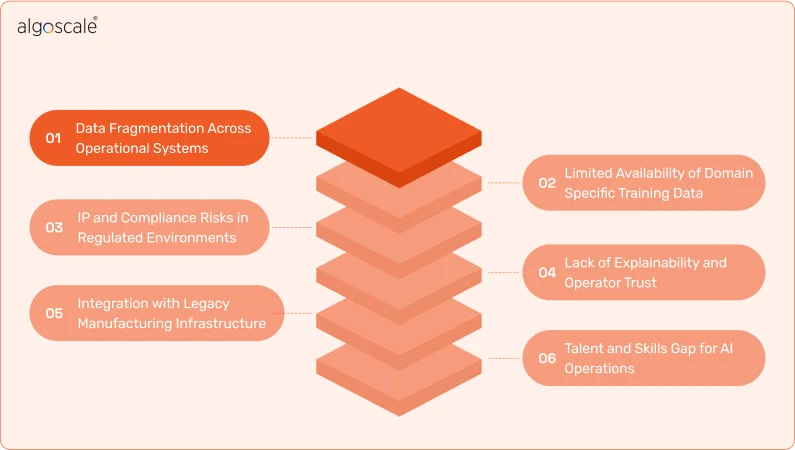
While Generative AI promises to revolutionize manufacturing, its implementation is not without obstacles. Below are critical, non-generic challenges that manufacturers face when integrating GenAI into their operations:
Data Fragmentation Across Operational Systems
Manufacturers typically operate with fragmented data across ERP, MES, SCADA, and PLM systems. GenAI models require access to high-quality, context-rich data across these sources. Without a unified data strategy or orchestration layer, the model’s output is either inaccurate or biased—limiting ROI and trust in AI-driven decisions.
Limited Availability of Domain-Specific Training Data
Unlike web-scale LLMs trained on internet text, generative models in manufacturing require niche data such as machine logs, CAD drawings, tool paths, and quality records. These are often proprietary, sparse, or not annotated—making it difficult to fine-tune models for industrial use cases like design optimization or automated work instructions.
IP and Compliance Risks in Regulated Environments
In industries such as aerospace, pharma, and defense manufacturing, Generative AI must adhere to strict compliance and traceability standards (e.g., FDA, ISO, AS9100). Generated outputs like BOMs, instructions, or simulations must be auditable, validated, and version-controlled. Without safeguards, GenAI poses IP leakage and regulatory non-compliance risks.
Lack of Explainability and Operator Trust
Manufacturing teams—including engineers and floor supervisors—often distrust “black box” AI outputs, especially when safety or precision is involved. Generative AI models must provide transparent, interpretable logic for design suggestions, root cause analysis, or process changes to gain operator buy-in and reduce friction in adoption.
Integration with Legacy Manufacturing Infrastructure
Factories often rely on legacy industrial equipment and systems with limited API access or digital connectivity. Integrating GenAI into these environments—especially for real-time applications like toolpath optimization or predictive maintenance—requires custom connectors, protocol handling, and IT/OT alignment, which slows down deployment.
Talent and Skills Gap for AI Operations
Implementing GenAI in manufacturing requires a hybrid skill set—understanding of AI/ML, knowledge of industrial engineering, and familiarity with production processes. Many manufacturers lack internal teams capable of building, fine-tuning, and governing GenAI applications, increasing reliance on external partners or platforms like Arcastra™.
How to Implement Generative AI in Manufacturing Workflows
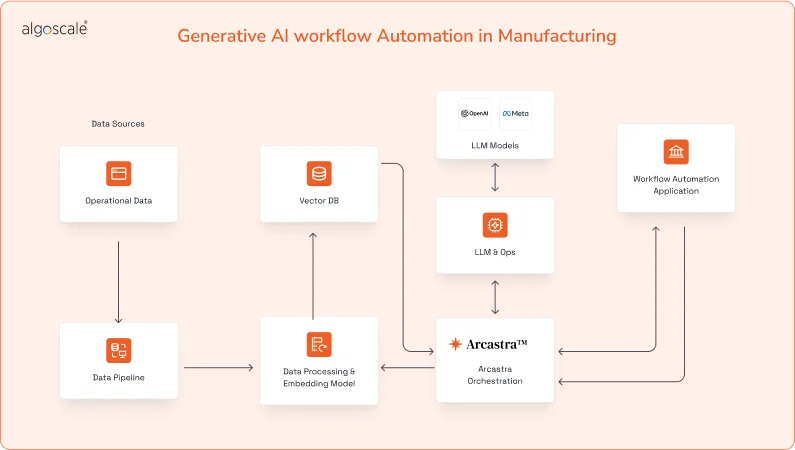
Implementing Generative AI in manufacturing is not simply about plugging in a model- it’s about redesigning workflows to accommodate AI-driven creativity, simulation, and decision-making across the production lifecycle, Below is a breakdown of how manufactures can practically integrate GenAI across design, engineering, production, and quality functions:
- Identify Bottlenecks Where Creative Intelligence Adds Value
Start with areas where traditional automation or rule-based systems plateau such as:
- Design iterations that take weeks due to simulation bottlenecks.
- Quality analysis that fails to find non-obvious cause chains.
- Procurement delays driven by unstructured communication.
- Documentation or regulatory processes that consume excessive manual hours.
“These are not just inefficiencies- they are opportunities where generative reasoning , multi-modal data processing, and iterative simulation can drive exponential value.
- Build a Multi-Modal Data Foundation
Generative AI is only as effective as the data it learns from- and in manufacturing, that data spans diverse formats:
- 3D CAD models and toolpath data
- Sensor logs from PLCs, CNCs, and SCADA systems
- ERP and MES records
- Quality inspection logs and human annotations
- Engineering documents, compliance manuals, technical drawings
This data must be unified, cleaned, and made contextually available to Gen AI models. Building vectorized embeddings for these varied sources is key to enabling AI-driven search generation and synthesis.
- Fine-Tune or Customize Foundation Models for Manufacturing Context
Generic LLMs like GPT or Claude are not trained on G-code, machine tolerances, BOMs or safety regulations. Manufacturers should fine-tune foundation models on
- Domain-Specific corpora
- Legacy engineering and service documentation
- Part-specific inspection records and quality reports
- Historical CAM programs and simulation results.
This tailoring ensures models not only understand manufacturing terminology but also generate outputs grounded in industrial logic and standards.
- Integrate GenAI into Human-in-the-Loop Workflows
Generative AI outputs — especially those related to design, documentation, or quality — must be vetted before deployment. Manufacturers should implement:
- Approval gates for design suggestions (e.g., AI-generated fixture layouts reviewed by manufacturing engineers)
- Version control with traceability for AI-generated code or documents
- Confidence scoring for root cause predictions to assist, not replace, quality teams
- Context preservation, so AI recommendations are aware of machine condition, shift data, and part versions
This collaborative framework ensures AI augments skilled labor without introducing risk.
- Deploy Use-Case-Specific Applications with Embedded AI
Rather than rolling out generalized AI chatbots, manufacturers should focus on task-specific GenAI modules that fit seamlessly into existing tools or dashboards. Examples include:
- A GenAI co-pilot inside a CAD tool that auto-suggests lightweighting designs.
- A compliance document generator that pulls directly from PLM and MES logs.
- A G-code auto-generator in CAM software that dynamically adjusts to material and machine specs.
A virtual quality analyst that generates RCA summaries based on inspection data and operator inputs.
Embedding AI where work already happens reduces resistance and increases utility.
- Ensure Robust Validation, Feedback, and Learning Loops
Because AI models learn from data — including real-world mistakes — it’s essential to build feedback pipelines:
- Capture where operators override or reject AI suggestions.
- Log downstream outcomes (e.g., defect rates, approval times) tied to AI outputs.
- Retrain or adjust model weights periodically based on real-world performance.
This turns AI from a static assistant into an adaptive asset that evolves with your operations.
- Build Governance Around IP, Safety, and Compliance
Generative AI introduces new questions around IP (e.g., who owns an AI-generated part design), safety (e.g., are AI-suggested processes compliant with ISO or FDA?), and traceability (e.g., who approved an AI-generated NC code).
Manufacturers must:
- Track model provenance and prompt history.
- Log human approvals and overrides.
- Establish audit trails for all GenAI-generated outputs.
- Ensure role-based access to AI tools in sensitive workflows.
Without this, manufacturers risk regulatory violations or production defects driven by poorly governed AI systems.
From Insight to Execution : Enabling Generative AI in Manufacturing with Arcastra™
As manufacturers sell from isolated AI experiments to integrated production-grade generative systems, the need shifts from “building models” to orchestrating intelligence.” Arcastra addresses this shift head-on not by being another GenAI platform, but by serving as the operational brain behind AI-powered manufacturing systems. It unifies data, models, APIs, human workflows, and enterprise logic into a coordinated, secure, and context-aware control layer with Acrastra, manufacturing move beyond disconnected AI tools into cohesive, decision-capable systems that operate at production speed and scale.
Orchestrating intelligence across the stack
Unlike traditional platforms that focus on app creation or model training, Acrastra acts as the autonomous coordination fabric that allows AI agents to execute complex, multi-step tasks across the enterprise. From querying engineering specs in PLM to triggering alerts in MES or synthesizing insights from SCADA logs, Arcastra enables agents to reason across systems- not just respond to them. Manufacturers no longer need to hardcode integrations or manually shuttle data between systems. Arcastra empowers GenAI agents to retrieve, interpret, and act– in real time and under governance.
Closing the loop between humans, machines, and data
Modern manufacturing workflows are inherently multi-agent: engineers, machines, ERP systems, quality logs, and vendor platforms all play a role. Arcastra operationalizes this complexity by enabling collaborative agent systems that dynamically interact with one another and with human-in-the loop checkpoints, For example, if a root-cause agent identifies a defect cluster, it can automatically notify a design agent to propose a geometry revision, while triggering alerts to human reviewers, These agents share memory, context, and state- operating like a coordinated digital workforce embedded inside the factory’s existing infrastructure.
Reducing Friction in AI deployment and scaling
Arcastra isn’t just built for the data science team. It’s built for the reality of enterprise operations, With declarative task orchestration, pre-integrated connectors, and modular blueprints for common GenAI workflows , Arcastra reduces the effort to go from prototype to production, Manufacturers can rapidly deploy agents that run securely across on-prem and cloud, and are governed with enterprise-grade access control,observability, and audit trails. No black boxes- every action is logged, explainable, and compliant,
Real-time manufacturing context as a first-class citizen
Manufacturing environments are dynamic: machine loads shift, upstream supply deals ripple through BOMs and regulatory constraints vary by region. Arcastra enables GenAI agents to act on live, contextual signals- pulling SCADA feeds, IoT telemetry, ERP status flags, or operator shift schedules in real time. This makes agent decisions responsive and situationally aware, rather than static or trained only on historical data. Whether adapting toolpaths to minimize spindle downtime or auto-adjusting part tolerances based on material quality logs, Acrastra allows GenAI to operate in true closed-loop feedback cycles,
Built for composability, governance, and scale
As AI maturity grows, so does the sprawl of models, tools, APIs, and workflows. Arcastra is built to contain that sprawl- acting as the layer of orchestration, not just execution. Its composable architecture supports model-agnostic integrations, enables secure API chaining, and maintains memory across interactions, Enterprises get unified observability across agents, centralized policy enforcement, and version-controlled orchestration logic ensuring that scaling AI doesn’t mean losing control. Arcastra future-proofs GenAI investments by abstracting away complexity while preserving control.
From data to action – not just dashboards
Most AI platforms stop at insight generation. Arcastra goes further by enabling autonomous action execution. If an agent detects non-conformance trends in inspection logs, it can update work instructions, notify the quality team, adjust the NC code for tolerance shifts, and confirm updated compliance protocols – all orchestrated through Arcastra. This turns GenAI from a passive advisor into an active operational agent embedded in the enterprise nervous system.
Arcastra doesn’t just help you build and grow with AI. It helps you manufacture with AI- securely, contextually, and at scale. By orchestrating tools, data, and decision logic into a unified generative layer, Arcastra allows manufacturers to evolve from AI-enabled to AI-operational.
To see how we’re also driving innovation in other sectors, check out our related services in Generative AI in finance and Generative AI in Healthcare.
Real Life Examples of Generative AI in Manufacturing Industry
Generative AI is not just enhancing workflows- it is actively transforming core processes in manufacturing organizations.From real-time design iterations to synthetic data generation and intelligent scheduling, leading manufacturers are embedding GenAI into critical functions like engineering design, predictive maintenance, QA, and operations. Below are five real life examples where major manufacturers have implemented generative AI to create measurable business impact.
Eaton: AI-Generated Topology Designs for Lightweight Parts
Use Case: Eaton leveraged generative AI to automate the design of lightweight, structurally optimized parts using topology optimization techniques. The AI system generates thousands of geometry variants based on mechanical constraints, material availability, and manufacturing cost, allowing for rapid exploration of feasible designs.
What Was Done: Eaton integrated aPriori’s generative design tools with its CAD ecosystem to compress the design-to-evaluation loop. Engineers received manufacturability-ready part designs with up to 80% weight reduction, reducing iteration cycles from weeks to hours. This helped Eaton meet both cost and performance goals in electric mobility and aerospace applications.
BMW: Quantum-Inspired AI for Production Scheduling
Use Case: BMW used a generative scheduling engine powered by Zapata Computing’s quantum-inspired optimizer, GEO, to tackle complex production planning problems. The AI system was designed to generate and evaluate millions of shift schedule combinations and resource allocation scenarios across manufacturing plants.
What Was Done: BMW applied the solution to optimize worker shifts and machinery workloads across plants in real-world tests. The GEO engine outperformed traditional solvers in over 70% of cases, reducing idle time and increasing production efficiency. This demonstrated generative AI’s potential for real-time, constraint-based orchestration of complex factory operations.
GE Aerospace: Synthetic Failure Pattern Simulation for Predictive Maintenance
Use Case: GE Aerospace applied generative models to simulate rare engine failure patterns for training its predictive maintenance systems. Given the high cost and rarity of certain failure modes, generating synthetic sensor logs allowed GE to build more robust diagnostics models.
What Was Done: By feeding AI-generated synthetic failure events into its ML training pipelines, GE Aerospace significantly enhanced the accuracy of its predictive systems. This enabled earlier detection of potential issues—up to 60% earlier—minimizing unplanned maintenance events and improving flight engine reliability.
Merck: AI-Created Defect Images for Pharmaceutical QA
Use Case: Merck utilized generative adversarial networks (GANs) to produce synthetic images of rare packaging defects in pharmaceutical production. This addressed the challenge of limited defective image data, which constrained traditional computer vision models used for quality assurance.
What Was Done: The GAN-based system enabled Merck to train inspection models on a broader range of defect patterns without needing to physically manufacture defective products. This improved the model’s ability to detect edge cases and reduced false positives by more than 50%, boosting both efficiency and product quality in the QA process.
Rolls-Royce: AI-Enabled Engine Health Monitoring and Maintenance Knowledge Access
Use Case: Rolls-Royce implemented a generative AI system through AWS’s Bedrock and Amazon Kendra platforms to synthesize maintenance documentation, engine telemetry, and engineering guidelines. This AI solution was built to surface maintenance procedures, part replacements, and engine diagnostics on demand.
What Was Done: Rolls-Royce technicians can now query GenAI-powered interfaces to get rapid insights into repair workflows, engine degradation signs, and compliance steps. Additionally, the AI continuously integrates real-time sensor data into the engine’s digital twin model, supporting proactive maintenance planning and reducing unscheduled downtime by hundreds of hours annually.
The Future of Generative AI in Manufacturing
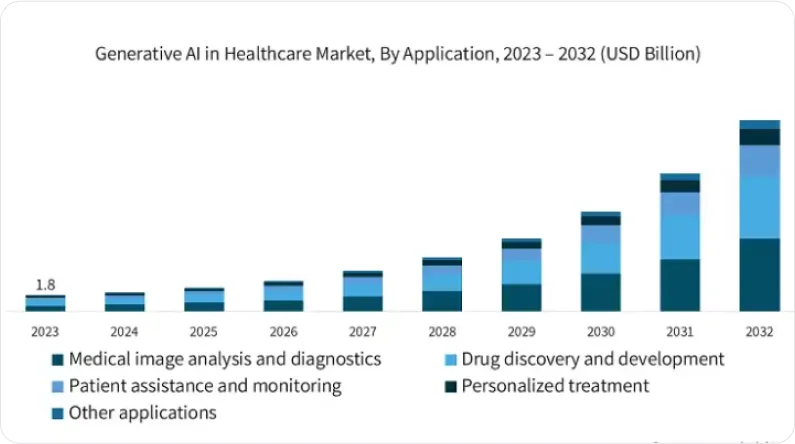
Generative AI is fast emerging as a transformative force in manufacturing, moving well beyond traditional automation into design, simulation, and decision augmentation. According to recent projections, the generative AI market in manufacturing was valued at approximately $225 million in 2022, and is expected to reach $6.96 billion by 2032, growing at a CAGR of over 39%. This exponential growth signals a major shift toward AI-native operations—where generative models will underpin everything from agile product engineering to intelligent supply chains and autonomous factory floors.
AI-Frist Engineering Workbenches
Generative AI is reshaping CAD/CAM environments into AI-first design platforms. In the future, engineers will co-create with AI agents that can instantly translate functional goals into manufacturable 3D models, conduct simulations, and recommend material/process trade-offs. These workbenches will be embedded with LLMs trained on domain-specific engineering and physics models—streamlining ideation to production in one continuous loop.
Closed-Loop Manufacturing Systems
Factories are evolving toward fully closed-loop systems where GenAI links real-time sensor data with design, operations, and quality control. The next phase will see generative models acting as autonomous reasoning layers—making on-the-fly adjustments to production schedules, machine settings, or material mixes in response to real-world deviations, without waiting for human intervention.
Generative AI-Native MES and ERP Layers
Traditional MES and ERP systems will evolve into AI-native orchestration layers. Instead of static logic trees, these systems will use generative reasoning agents to infer bottlenecks, suggest process improvements, and even simulate business outcomes before changes go live. Enterprises will use prompt-based interfaces to plan and manage supply chains, quality programs, and compliance audits.
Simulation-Led Supply Chain Planning
Generative AI will increasingly be used to create thousands of demand-supply simulation scenarios, factoring in geopolitical risk, climate events, and market signals. These simulations won’t just inform decisions—they’ll automate planning cycles in near real-time. Manufacturers will rely on AI agents to generate optimal sourcing routes, inventory targets, and contingency plans without waiting for historical data accumulation.
Regulatory-Aware Co-Pilot Agents
In highly regulated industries, future GenAI applications will feature built-in compliance knowledge—generating documentation, audit trails, and even design decisions that are automatically aligned with FDA, ISO, AS9100, or ITAR standards. This will shift compliance from a manual, after-the-fact task to an embedded, real-time function of product development.
Human-Machine Design Collaboration at Scale
Designers and shop-floor workers will work alongside specialized AI agents capable of interpreting visual, textual, and spoken inputs. These multi-modal interfaces will allow frontline workers to instruct AI in natural language—whether it’s modifying a part geometry, adjusting a welding sequence, or querying root-cause analysis. The GenAI of the future will act more like a skilled team member than a tool.
Digital Twins Powered by Generative Simulations
Tomorrow’s digital twins will not just reflect the real world—they will evolve and adapt through generative simulations. AI will simulate aging, fatigue, thermal drift, and wear in machines and processes, allowing manufacturers to optimize predictive maintenance and redesign physical assets proactively, before failure ever occurs.
Conclusion
The rise of generative AI is not just another technological evolution for the manufacturing industry- it’s a foundational shift in how products are imagined, processes are optimized, and decisions are made at scale. From intelligent design automation to dynamic BOM generation to synthetic data for digital twins and autonomous documentation, the real-world use cases we’ve explored highlight a clear trend: manufacturers who leverage generative AI now will define the competitive landscape tomorrow.
At the heart of this transformation is the need for intelligent orchestration and scalable deployment, which is where Algoscale delivers a unique edge. Our proprietary full-stack AI orchestration platform, Arcastra™, enables manufacturers to operationalize generative AI across complex systems and workflows- securely, efficiently, and with enterprise-grade scalability. Arcastra empowers AI agents to not only generate insights but to retrieve, reason, act and collaborate across data, APIs, and operational tools – driving real-time business value on the factory floor and beyond.
Whether you’re exploring your first use case or scaling AI across global operations, Algoscale stands ready to be your ai services and data consulting partner in building AI-native manufacturing capabilities that are agile, resilient, and future-proof. The journey to intelligent manufacturing isn’t ahead- it’s underway, The time to act is now.
Frequently Asked Questions
What is Generative AI in Manufacturing?
Generative AI in manufacturing refers to the use of AI models to create designs, generate code, simulate scenarios, and automate complex decision-making tasks across engineering, production, and supply chain functions.
How is Generative AI different from traditional automation?
Traditional automation follows fixed logic, while Generative AI can learn from data, generate new outputs, and adapt to changing conditions—making it useful for creative and analytical tasks like design, optimization, and diagnostics.
What are the challenges in adopting Generative AI in manufacturing?
Key challenges include data silos, model integration with legacy systems, regulatory compliance, and change management. Platforms like Arcastra™ help bridge these gaps through orchestration and secure deployment.
Can Generative AI improve product quality ?
Yes. Generative AI supports root cause analysis, predictive quality control, and real-time instruction updates—leading to reduced defect rates and improved consistency across production lines.
How secure is the use of GenAI in manufacturing environments?
With enterprise platforms like Arcastra™, Generative AI solutions can be deployed securely, with role-based access, audit trails, and compliance frameworks aligned with manufacturing IT/OT standards.
What industries within manufacturing benefit most from Generative AI?
High-precision and complex industries like aerospace, automotive, electronics, and medical devices see the most immediate benefits due to their need for rapid design iteration, quality control, and regulatory documentation.

Sai Aparna
Sai Aparna Pochiraju is a Content Marketer with nearly four years of experience in digital marketing. She specializes in content strategy and brand storytelling, helping businesses engage audiences and achieve measurable digital growth.