
The AI Renaissance in Banking
Decades ago, banking was defined by mahogany desks, ledger books, and human memory. Transactions were manual, customer service lived behind the counters, and decision-making moved at the pace of paperwork. Today, that world feels almost unrecognizable. From real-time fraud detection to AI copilots advising on investments, generative AI in banking is evolving from transactional service to an intelligent, generative ecosystem faster than ever before.
Just imagine a world where a chatbot isn’t just answering FAQs but drafting regulatory reports. Where loan offices are equipped with AI copilots summarizing a customer’s 5-year financial journey in seconds. Where fraud detection evolves from rules-based filters to models that learn and adapt in real-time. That world isn’t a future scenario- it’s unfolding right now.
Generative AI, the class of AI models capable of creating text, images, code, and more, is no longer a novelty for innovation labs. It’s a strategic lever for transformation across the global banking systems. With McKinsey projecting AI to deliver up to $1 trillion of annual value across global banking, the financial services industry is not just experimenting – it’s racing ahead.
Whether it’s large multinational banks or nimble digital-first neobanks, institutions are investing in GenAI to enhance productivity, reduce costs, and unlock entirely new revenue models. The question has shifted from “Should we adopt GenAI?” to “How fast can we scale it?”
What Does Generative AI Mean to Banking?
At its core, Generative AI for banking empowers banks to think, respond, and create at machine speed. Unlike traditional AI models trained to classify or predict , GenAI can generate entirely new content- from underwriting documents and investment summaries to code for compliance workflows.
Reimagining Processes, One Model at a Time
Banks sit atop oceans of structured and unstructured data -PDFs, call transcripts, transcripts, transaction histories, and more. GenAI models, particularly Large Language Models (LLMs) like GPT-4, Claude, and custom domain-specific variants, are capable of digesting these diverse datasets and generating insights that previously required human analysts.
Take Morgan Stanley, for example. The bank deployed OpenAI-powered copilots that help financial advisors tap into over 100,000 pages of internal research and documentation – instantly. Instead of manually searching advisors now ask questions conversationally and receive context-aware summaries in seconds.
Performance That Goes Beyond Proof-of-Concept
According to Accenture’s 2024 Banking Trends report, banks can unlock a 30% boost in productivity by embedding GenAI into core business processes like customer onboarding, KYC, and loan processing. These aren’t abstract gains -real banks are already seeing reduced turnaround times, improved compliance accuracy, and elevated customer experiences.
The market echoes this urgency. As per Precedence Research, the global market size for Generative AI in finance is projected to grow at a CAGR of 33%, reaching $21.8 billion by 2034. What started as pilot projects in innovation teams is now becoming an enterprise-wide imperative.
Beyond Automation : Toward Strategic Differentiation
Generative AI for finance value isn’t limited to operational efficiency. It also opens up new frontiers for competitive advantage- from hyper-pesonalized financial advice and dynamic pricing models to real-time portfolio rebalancing and conversational banking agents that feel truly human,
In short, Generative AI is banking’s new engine – fueling a fundamental shift from legacy systems to intelligent, adaptive financial ecosystems that are proactive, not just reactive.
Why is Generative AI in Banking Important?
In an industry where milliseconds impact market positions and regulatory gaps and cost millions, Generative AI is no longer a curiosity – it’s a competitive necessity. Banks and financial institutions are not merely adopting GenAI to optimize – they’re using it to redefine how banking is done.
Replacing Rigid Playbooks with Dynamic Intelligence
For decades, banking operations followed fixed workflows: document review, compliance checks, customer onboarding, credit assessments – each siloed and governed by static rules. Generative AI is breaking those silos, Models are now capable of interpreting legal language, drafting financial documents, summarizing earning calls, and even generating audit-ready compliance reports.
This isn’t just automation -it’s augmentation. An AML officer can prompt the GenAI system with “flagged transaction history” and receive a narrative report that would otherwise take hours to compile. A wealth manager can input client sentiment data and receive tailored investment briefs generated on the fly.
Unlocking New Dimensions of Customer Experience
Retail and corporate clients alike are demanding smarter, faster, and more humanlike interactions, GenAI is fueling the rise of adaptive banking interfaces- virtual agents that can understand context ,tone, financial and intent.
Imagine a virtual assistant that doesn’t just answer, “What’s my balance?- but interprets spending patterns and advises:
“You’re on track to exceed your discretionary budget this month. Would you like to move $500 from your emergency fund instead of triggering an overdraft?”
This level of interaction is being piloted across top-tier banks, where GenAI agents are trained not only on public data but also on proprietary financial models, customer personas, and risk profiles. The result? Conversations that feel consultative, not robotic.
Elevating Risk, Compliance, and Audit Operations
Risk and compliance are here GenAI shows its most immediate ROI. These functions are traditionally human-heavy, document-laden,and burdened by regulatory volatility. Now, AI copilots are parsing complex regulations, comparing them against internal policies, and suggesting gaps – without human bias or fatigue.
In credit risk, generative models are being used to simulate thousands of macroeconomic scenarios and stress-test portfolios beyond what’s possible with traditional statistical methods. In trade surveillance, synthetic data generation helps model rare but high-risk behavior – sharpening the bank’s ability to detect fraud before it happens.
A New Paradigm for Speed, Scale, and Strategy
What’s shifting is the mindset. GenAI is no longer delegated to innovation labs or skunkworks teams, Banks are embedding it into loan processing systems, document workflows, pricing engines, marketing ops, and even policy development. Instead of waiting weeks for reports, decision-makers now receive structured, explainable summaries within minutes – generated from millions of data points across formats.
For enterprise-scale institutions, this means quicker turnaround, smarter decisions, and scalable creativity. For fintech disruptors, this means competing on intelligence, not just interface.
In the world of finance , precision and speed are table stakes. Generative AI gives banks something rarer: the ability to reason, adapt, and act- in real time, across every layer of the business.

Generative AI Models that Find Application in the Finance Industry
The financial sector is undergoing a structural AI shift—not just adopting generative models, but integrating them into the core of product design, compliance automation, investment strategy, and customer engagement.
While foundational models like GPT-4 dominate headlines, the real story lies in how a diverse ecosystem of generative models from large language to diffusion to fine-tuned vertical AI is being used across front, middle, and back offices in finance.
Generative AI integration services are playing a crucial role in enabling this seamless adoption across financial operations.
Below is a breakdown of the leading GenAI model types making the deepest impact in banking and finance:
1. Large Language Models (LLMs)
Model Overview: Large Language Models are advanced AI systems trained on vast amounts of textual data to understand and generate human-like language. In the finance sector, LLMs are utilized for tasks such as automating report generation, facilitating financial Q&A bots, translating and summarizing documents, and interpreting regulatory updates. These models enhance efficiency by providing quick, accurate, and context-aware responses, thereby streamlining operations and decision-making processes.
Tools and Platforms
OpenAI’s – GPT-4 and GPT-4 Turbo
OpenAI’s GPT-4 series stands as a cornerstone in financial AI applications. With an estimated 175 billion parameters, these transformer-based models excel in understanding and generating human-like text. Their capabilities extend to drafting financial reports, analyzing market trends, and automating customer service interactions. The “Turbo” variant offers optimized performance, balancing speed and cost, making it suitable for real-time financial applications.
Claude 3 Opus (Anthropic)
Anthropic’s Claude 3 Opus is designed with a focus on safety and interpretability. This model is adept at complex reasoning tasks, making it valuable for financial forecasting and compliance analysis, Its architecture
Google’s Gemini
Google’s Gemini integrates seamlessly with Google Workspace, offering tools that aid in understanding complex financial data. It enables users to create formulas, pivot tables, and summarize reports efficiently. Financial professionals utilize Gemini to streamline data analysis processes, generate executive summaries, and enhance collaborative efforts within organizations.
Meta’s LLaMA 2
An open source model that allows financial organizations to customize and deploy AI solutions tailored to their specific needs. By offering access to model weights and starting code, LLaMA 2 allows for the development of tailored applications that can handle tasks ranging from customer service automation to financial forecasting, all while maintaining control over data privacy and compliance.
2. Document Intelligence Models
Azure Document Intelligence
It offers robust capabilities of processing and analyzing financial documents. This model utilizes optical character recognition and machine learning to extract relevant information from various document types, including invoices, receipts, and contracts. Financial institutions employ Azure Document Intelligence to automate data entry, reduce manual errors, and integrate extracted data into enterprise resource planning systems for further processing.
Google Document AI
It provides tools to parse and understand complex documents, enhancing data extraction and processing efficiencies. It enables financial organisations to automate the handling of unstructured data, such as loan applications and insurance forms, by converting them into structured formats suitable for analysis and storage. This automation leads to improved operational efficiency and faster decision making processes.
3. Conversational AI Models
Amazon Lex
This tool facilitates the creation of conversational interfaces using voice and text, assisting in customer service and support within the financial sector. It enables the development of chatbots that can handle tasks such as checking loan application statuses, making payments, and addressing frequently asked questions. By integrating Amazon Lex, financial institutions can enhance customer engagement and streamline service delivery.
Google Dialogflow
It is a natural language understanding platform that simplifies the design and integration of conversational user interfaces. In finance, Dialogflow is used to build chatbots capable of understanding and responding to customer queries effectively, thereby improving customer experience and operational efficiency.
Kasisto’s KAI
Kasisto’s KAI is a conversational AI platform specifically designed for banking and financial services. It empowers banks and credit unions to deliver personalized, predictive, and proactive customer and employee experiences. KAI applications recognize and respond intelligently to a wide range of human language inputs, providing accurate information and assistance across multiple digital channels.
4. Code Generation Models
Github Copilot
Github Copilot serves as an AI-powered coding assistant that suggests code snippets and entire functions in real-time. In the financial industry, developers utilize copilot to accelerate software development processes, improve code quality, and reduce the time required for routine coding tasks. This tool enhances productivity and supports the rapid development of financial applications.
Amazon CodeWhisperer
Amazon CodeWhispere is a machine learning-powered code generator that provides real-time code recommendations. It assists developers in writing secure and efficient code by suggesting functions, classes, and algorithms based on the context of the existing code. Financial institutions leverage CodeWhisperer to streamline the development of applications and ensure adherence to coding best practices.
Google Duet AI
This acts as an AI collaborator within Google Cloud, offering assistance to users of all skill levels. It provides help in analyzing data, creating custom plans, and automating tasks within applications like Google sheets. Financial professionals use Duet AI to enhance data analysis capabilities and improve decision making processes.
5. Synthetic Data Generation Models
Syntho specializes in generating high-quality synthetic data, enabling financial organizations to enhance risk assessment, fraud detection, algorithm training, and software development while preserving data privacy. By using synthetic data, institutions can comply with data protection regulations and facilitate innovation without exposing sensitive data and information.
Mostly AI
This application provides synthetic data solutions that allow financial institutions to share and analyze data without compromising privacy. Its platform supports advanced analytic, machine learning, and software testing by generating data that maintains the statistical properties of real datasets. This approach enables safe data sharing and accelerates AI development.
Gretel
This offers a synthetic data platform that helps financial organizations unlock the value of their data while maintaining high privacy and quality standards. It supports use cases such as preventing data leaks, sharing data across organizations, and reducing compliance overhead,thereby facilitating secure and efficient data utilization.
6. Scenario Simulation & Risk Modeling Models
Feedzai
This application utilizes AI to detect and prevent fraud, offering real-time risk assessment and transaction monitoring solutions. Its platform helps financial institutions identify and mitigate potential threats, ensuring the security of financial transactions and enhancing trust among customers
Ayasdi (Symphony AI)
Ayasdi, now part of Symphony AI, employs advanced analytics to identify patterns and anomalies, enhancing anti-money laundering efforts. Its AI-driven solutions assist financial institutions in uncovering hidden risks and ensuring compliance with regulatory requirements.
SymphonyAI provides AI-driven solutions for risk modeling and scenario analysis,supporting informed decision-making in financial institutions. By simulating various financial scenarios, SymphonyAI enables organizations to assess potential risks and develop strategies to mitigate them effectively.
These generative AI tools, platforms, and generative AI development services are integral to modernizing the finance industry, offering solutions that enhance efficiency, accuracy, and compliance. By adopting these technologies, financial institutions can stay competitive and responsive in a rapidly evolving landscape.
How to Implement Generative AI in Banking and Finance Operations?

Implementing Generative AI in banking is a multi-layered process that requires not only technical sophistication but also domain understanding. From data readiness to model orchestration and governance to application delivery, it demands a strategic roadmap that only the AI solution providers can effectively navigate.
- Identify High-Impact Use Cases– Pinpoint processes that benefit most from GenAI- like customer support, compliance automation, fraud detection or hyper-personalized financial advising.
- Prepare and Secure Your Data– Aggregated strictured and unstructured data from CRMs, transactions, KYC records, and behavioral sources. Privacy, consent, and regulatory compliance must be embedded in the data pipelines.
- Choose or Train Suitable LLMs – Select pre-trained domain specific models or fine-tune foundation models like GPT or LLaMA for targeted tasks such as summarization, intelligent search or generation.
- Orchestrate Model Operations in Real Time– Deploy orchestration layers to manage prompt flows, performance tuning, latency control, and continuous learning via user feedback.
- Deliver via Financial Applications – Deploy GenAI within customer-facing tools or internal platforms – such as intelligent chatbots, real-time compliance assistants, risk profiling systems, or document processors.
How Algoscale Brings This to Life (with Arcastra™)
While most banks know what to implement, Algoscale focuses on how to do it right – securely, scalably, and with real-time intelligence.
At the heart of our GenAI approach is Arcastra™, a proprietary orchestration platform that aligns intelligent agents, data infrastructure, and automation workflows into a single control layer.
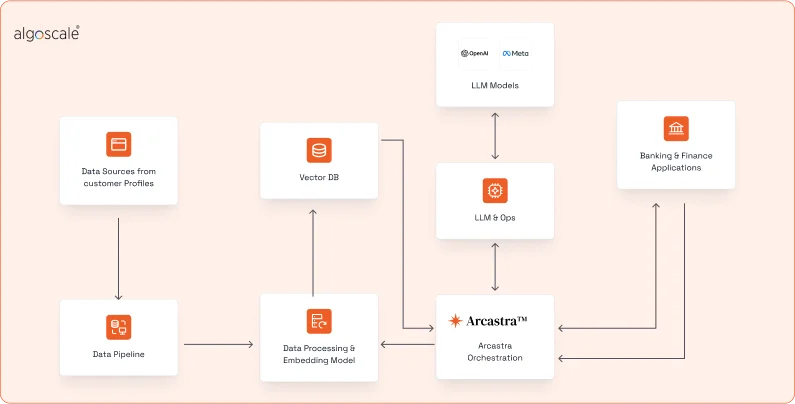 Here’s how Algoscale enables end-to-end GenAI adoption for financial institutions:
- Data Pipeline : We ingest data from multiple sources – customer profiles, transactions, documents – and process it through a secure, complaint pipeline.
- Embedding & Vector DB : Using cutting-edge embedding models, data is transformed into vector formats and indexed for fast, semantic search.
- LLM & Ops Layer : We connect to LLMs like OpenAI etc, with an operational layer to manage prompts, model performance, and versioning,
- Arcastra Orchestration : This is where our stack becomes unique. Acrastra dynamically connects the LLMs, data systems, and finance applications – enabling real-time, secure GenAI operations.
- Application Delivery: Whether it’s a chatbot, smart dashboard, or compliance engine, we deploy GenAI solutions tailored to your use case-fast and with zero disruption.
- Feedback Loop : The system continuously learns from user interaction, improving responses and outcomes over time.
With Algoscale, financial institutions don’t just deploy GenAI – they unlock it as a production-grade capability. As one of the top generative AI consulting companies, our expertise lies in turning complex ideas into real time, secure, and high impact financial applications.
Generative AI Use Cases in the Banking & Financial Industry
The banking and finance sector has always thrived on precision, speed, and trust – but the rules of the game are evolving. With data volumes surging and customer expectations shifting towards instant, hyper-personalized experiences, financial institutions can no longer rely solely on traditional systems. Enter Generative AI for banking : not just a technological upgrade, but a paradigm shift. From enhancing back-office efficiency to redefining how customers interact with money, GenAI is weaving itself into the fabric of modern finance.
Below are 10 transformative use cases where generative AI is making a measurable impact across the financial ecosystem:
1. Automated Financial Report Generation
Gone are the days when analysts spent weeks compiling quarterly reports. Generative AI can ingest structured data (like balance sheets or cash flow statements) and unstructured data (such as market commentary or CEO transcripts) to automatically generate polished financial reports, investment decks, and earnings summaries. Banks and wealth management firms are using tools like S&P Global’s Kensho and Salesforce’s Einstein GPT to generate client-ready narratives in real time — improving turnaround time and eliminating human error.
2. Customer Support Chatbots and Voice Assistants
Banks are deploying generative AI chatbots and voicebots trained on institution-specific data to deliver conversational banking experiences. These assistants not only respond to routine questions (account balances, branch hours, transaction issues), but also offer empathetic, human-like dialogue in multiple languages. Solutions like Kore.ai and Nuance AI integrate GenAI with banking CRMs to ensure context-aware support that reduces call center volumes and increases CSAT scores.
3. Hyper-Personalized Financial Recommendations
With GenAI, banks can now provide individualized financial coaching at scale. By analyzing behavioral spending patterns, credit histories, and life events, LLMs generate tailored suggestions for savings, retirement planning, or investment diversification. Think of it as a robo-advisor with the contextual awareness of a human — capable of evolving recommendations as market conditions and customer needs shift.
4. Loan Summarization and Underwriting Support
Traditional loan processing often involves combing through lengthy documentation — tax returns, pay slips, property titles — a process prone to delays. Generative AI models like GPT-4 and Amazon Titan can summarize and validate this information instantly, supporting underwriters with risk assessments, red flag alerts, and approval recommendations. This not only accelerates decision-making but ensures greater consistency and compliance.
5. Regulatory Compliance and Policy Intelligence
Staying ahead of evolving global regulations is a never-ending task for financial institutions. Generative AI models are being trained on policy updates, legal notices, and compliance manuals to provide real-time alerts and clause-level risk summaries. JPMorgan’s in-house solution, COIN, is one example — reviewing 12,000 contracts in seconds. These models reduce compliance risk and free up legal teams for higher-order tasks.
6. Fraud Detection Through Behavior Simulation
Generative models can simulate billions of transactions to identify anomalous behavior indicative of fraud. Unlike rule-based systems that flag only known patterns, GenAI anticipates and adapts to evolving threat vectors by learning from emerging transaction dynamics. Companies like Feedzai and SymphonyAI are integrating these capabilities into fraud detection engines to identify threats before they escalate.
7. Synthetic Data Creation for Model Training
Privacy and data scarcity often hinder model training in finance. GenAI solves this by creating synthetic datasets that mimic real-world financial behavior without exposing sensitive information. These datasets are used to train models in areas like credit scoring, anti-money laundering (AML), and risk profiling — especially in regions with limited data infrastructure or strict data sovereignty laws.
8. Automated Marketing Campaigns and Personalization
Generative AI is streamlining the creative process behind marketing campaigns. Whether it’s generating personalized email copy, designing banner ads, or creating A/B tested landing pages, GenAI models like Jasper and Copy.ai are helping banks reach their customers with content that adapts to demographics, behavior, and intent — all while staying compliant with financial advertising regulations.
9. Scenario Forecasting and Stress Testing
Banks use generative models to simulate economic crises, market crashes, and liquidity shocks. These “what-if” engines help CROs and CFOs understand vulnerabilities across asset classes, geographies, or client segments. Models like BloombergGPT are being trained on both market and macroeconomic data to provide nuanced scenario narratives, enabling smarter hedging and portfolio allocation decisions.
10. AI-Powered Financial Education and Wealth Coaching
GenAI is also democratizing financial literacy. Banks are launching AI tutors that guide users through complex topics like compound interest, portfolio diversification, or tax planning. These assistants adapt based on user comprehension levels and regional financial norms, making them particularly powerful in emerging economies where formal financial education is lacking.
Generative AI in Banking : Key Benefits
Adopting generative AI in banking and for finance isn’t just a matter of keeping up with technological trends-it’s about redefining how financial institutions operate, innovate, and connect with customers. While traditional AI models have already made significant inroads in fraud detection, algorithmic trading, and automation, generative AI goes a step further – creating content. Interactions, and solutions that feel deeply human, contextually aware, and continuously adaptive.
Below are the most critical benefits financial institutions are already unlocking through enterprise-grade generative AI deployments:
Faster Decision- Making Across Core Process
One of the most tangible benefits of generative AI is speed – not just in automation, but in reasoning. GenAI empowers banks to synthesize data across silos, summarize long-form documents, and generate contextual responses within seconds. Whether it’s accelerating KYC verifications, risk assessments, or loan approvals, decision-making cycles that once took days are now happening in real-time.
Significant Cost Reduction and Operational Efficiency
By automating labor-intensive tasks such as document generation, report writing, and customer query resolution, generative AI is cutting operational costs dramatically. For instance AI copilots are replacing repetitive backend workflows, freeing up human teams to focus on high-value analysis. According to McKinsey , GenAI could reduce banking operational costs by up to 20-30% annually when applied at scale.
Hyper-Personalization at Scale
Banks have always struggled to tailor services to individual customers without ballooning service costs. GenAI enables hyper-personalized experiences — from dynamic financial advice to real-time investment recommendations — without needing human intervention. The result is deeper customer engagement, improved loyalty, and increased wallet share.
Enhanced Regulatory Compliance and Risk Management
Compliance is no longer about ticking checkboxes — it’s about anticipating risk and ensuring real-time alignment with complex regulatory environments. Generative AI supports this by continuously reading and interpreting new regulations, summarizing impact, and surfacing actionable changes. It also enhances audit trails by generating explanatory notes, risk justifications, and compliance-ready reports automatically.
24/7 Conversational Banking and Support
Generative AI for banking has given rise to intelligent banking assistants that are available 24/7 — offering not just scripted answers, but nuanced, context-aware conversations. These assistants can handle multilingual support, sentiment analysis, intent recognition, and even emotional empathy. As a result, banks can deliver continuous customer engagement without ramping up support costs.
Increased Accuracy in Forecasting and Strategic Planning
Traditional forecasting tools often miss real-time context or emerging patterns. GenAI changes that by processing vast, real-time datasets and generating scenario analyses that incorporate sentiment, global events, and microeconomic signals. CFOs and risk teams are now using GenAI to generate dynamic liquidity models, stress-testing simulations, and market forecasts — improving both short-term agility and long-term planning.
Agility in Product and Service Innovation
Launching a new banking product typically involves months of market research, documentation, internal reviews, and customer education. GenAI shortens this lifecycle. From generating regulatory-compliant product documentation to simulating customer journeys, teams are now experimenting and iterating faster than ever before — bringing new services to market in weeks, not quarters.
Whether you’re looking for a strategic roadmap or turnkey deployment, Algoscale stands out among the top AI consulting companies and AI solution providers. Our expertise in generative AI consulting services is already transforming BFSI, e-commerce, legal analytics, and telco services — helping institutions unlock the full potential of enterprise-grade GenAI.
Generative AI in Banking Potential Challenges
As banks and financial institutions accelerate the adoption of generative AI, they’re uncovering complex operational hurdles that go well beyond model accuracy or infrastructure readiness. Unlike generic enterprise use cases, the financial sector demands precision, transparency and explainability – often in real time and under strict regulatory oversight.
Here’s a closer look at the nuanced, industry-specific challenges banks face when integrating generative AI into their ecosystems.
Hallucination in Critical Risk Scenarios
In high-stake use cases like loan approval or transaction monitoring,even a single hallucinated output from a language model can result in regulatory violations, reputational damage, or financial loss. LLMs still lack the deterministic behavior that banks require in risk-sensitive decisions.
Compliance Drift in Prompt-Driven Workflows
Generative systems evolve rapidly through prompt tuning and contextual injection. However these changes often go undocumented- making it difficult to recreate to audit AI-driven outcomes in accordance with regulatory mandates like Basel III or PCI DSS.
Feedback Loops Can Amplify Faulty Behavior
AI systems that incorporate feedback to self-improve risk reinforcing flawed decisions. In banking, this creates a compounding effect – where errors in loan recommendations or financial advice can snowball and impact entire portfolios.
Model Access Control in Hybrid Teams
In a regulated setting like banking, granting access to model parameters, prompts, or outputs requires granular control. But AI platforms often lack native features for secure collaboration among risk teams, engineers, and third-party tech vendors.
Difficulty in Grounding LLMs in Bank-Specific Knowledge
Generative AI models are typically trained on public web data. Without custom grounding internal policy documents, CRM entries, or transaction codes, they may fail to interpret proprietary banking terms or legacy workflows- leading to subpar outcomes.
Real-Time Integration Bottlenecks
Financial services increasingly require instant decisions – from real-time fraud detection to on-the-fly KYC checks. But latency from API calls, prompt processing, or model orchestration can break mission-critical SLAs and customer experience metrics.
Overdependence on Vendor APIs for Decision-Making
Many GenAI deployments rely on external APIs (e.g., OpenAI, Claude, Gemini) to power internal decisions. This introduces third-party risk, especially when there’s limited insight into how those models generate outputs or handle banking data.
Prompt Engineering Resource Constraints
Effective GenAI systems in banking require rigorous prompt engineering — aligned with brand tone, compliance language, and domain logic. But most banks lack in-house expertise, and underinvesting here leads to brittle, low-accuracy models.
Lack of Multi-Language & Code-Switching Support
In multilingual markets like India or Southeast Asia, customers often mix languages in queries (e.g., “Mujhe last EMI amount batayein”). LLMs without fine-tuning on such code-switched data may struggle to comprehend or respond correctly.
Operationalizing AI Within Rigid Core Banking Systems
Legacy tech stacks in banking weren’t designed for continuous learning, prompt injection, or real-time GenAI inference. Marrying new-age AI with these systems requires a deep transformation of infrastructure, APIs, and data access layers.
Generative AI in Banking Trends: Shaping the Future
As banks evolve from digital-first to AI-native organizations, generative AI for finance and banking is becoming a strategic differentiator. No longer limited to experimental pilots, GenAI is now embedded in enterprise workflows – powering everything from risk analysis to hyper-personalized financial journeys. What’s emerging now are trends that reflect both technological maturity and the growing trust banks are placing in AI systems.
Let’s explore the most notable generative AI trends redefining the banking industry:
Fine-Tuning Foundation Models for Financial Microdomains
Banks are moving away from generic LLMs to models fine-tuned on domain-specific corpora — including underwriting guidelines, policy documents, historical call logs, and financial regulations. This shift improves both response accuracy and compliance alignment.
AI Agents Replacing Static Chatbots
The transition from rule-based chatbots to autonomous, multi-turn AI agents is accelerating. These agents handle everything from account servicing to loan eligibility checks — using memory, reasoning, and dynamic goal pursuit, not just scripted flows.
Retrieval-Augmented Generation (RAG) Becomes Standard
To improve grounding and reduce hallucinations, banks are adopting RAG pipelines that let GenAI models fetch real-time knowledge from internal sources (e.g., knowledge bases, PDFs, KYC systems) before generating a response. This dramatically boosts output relevance.
Feedback Loops Power Real-Time Learning
More institutions are designing AI systems that learn continuously from customer interactions, employee validation, and model correction data. These reinforcement loops turn generative AI into a living system that improves with every engagement.
Multilingual GenAI for Inclusive Banking
As banks expand into underserved and multilingual markets, GenAI models are being fine-tuned to understand code-switched queries and local dialects. This enables inclusive service delivery across geographies without building separate systems.
GenAI Embedded in Core Systems via Microservices
Rather than treating GenAI as a bolt-on tool, banks are embedding LLMs into core workflows via microservices — from underwriting and credit scoring to AML checks and claims automation. This ensures modularity and real-time processing.
Generative AI for Internal Knowledge Enablement
Beyond customer-facing use cases, banks are using GenAI to create internal copilots for risk officers, relationship managers, and compliance teams — offering instant access to internal policy, product info, and training material via natural language queries.
Prompt Governance and Access Control as Enterprise Features
With prompts driving core financial decisions, governance tools are evolving to track, version, and audit prompt history. Banks now treat prompt flows like code — securing them under RBAC and compliance flags.
Synthetic Data Generation for Model Training
To mitigate privacy risks, banks are using GenAI to generate synthetic yet statistically valid customer datasets. This enables model training without compromising real customer data or violating GDPR/DPDP mandates.
LLM-Powered Personal Finance Advisors
Hyper-personalized banking experiences are being reimagined with LLM-based advisors — capable of offering investment insights, budget coaching, and goal tracking based on a user’s spending patterns and preferences, all through natural language.
Future Implications and Opportunities of Generative AI in Banking Industry
Generative AI is not just a technological evolution—it marks a fundamental shift in how banks will operate, innovate, and deliver value in the future. As foundational models grow more context-aware, multimodal, and enterprise-grade, the potential to transform nearly every aspect of banking becomes both a challenge and a remarkable opportunity.
While most current deployments revolve around efficiency and experience—automating support, streamlining documentation, or enhancing customer engagement—the next phase of GenAI in banking will be defined by strategic enablement.
Reimagining Business Models
Generative AI opens the door to banking-as-a-service models where hyper-personalized offerings are created in real-time. From modular financial products to on-demand risk scoring and embedded finance, GenAI will enable banks to dynamically assemble services tailored to microsegments of users, even down to the individual level.
Autonomous Decision-Making
With real-time data ingestion and continuous learning loops, future banking systems will feature AI agents capable of low-risk autonomous decision-making. Tasks like transaction monitoring, portfolio rebalancing, or internal audits may be partially or fully AI-driven—reducing human workload while increasing precision.
Continuous Compliance & Regulatory Transformation
Regulations are becoming more adaptive, and so should compliance. Generative AI can interpret, adapt, and apply evolving regulations in real-time across jurisdictions. In the future, banks may use GenAI to simulate policy changes, stress-test compliance readiness, and automate filings with audit trails embedded.
AI-First Risk Management Frameworks
Traditional risk management is reactive; GenAI will make it proactive. Using a combination of generative simulations, scenario modeling, and synthetic stress testing, banks can predict and mitigate emerging risks before they escalate—especially in volatile markets.
Financial Advisory at Scale
Future AI advisors will combine natural language generation with predictive analytics to offer deeply personalized financial guidance—not just prebuilt advice but evolving strategies that adjust to a user’s behavior, spending, life events, and goals in real time.
AI-Enabled Partnerships & Ecosystem Play
As banks embrace API-first architectures and open finance, Generative AI in finance can facilitate automated partner onboarding, due diligence, and product co-creation across ecosystems. AI will play a central role in coordinating multi-party services in areas like lending, insurance, and wealth management.
AI as a Workforce Multiplier
Rather than replacing jobs, GenAI will become a powerful augmentation layer—helping analysts, advisors, and operations teams move from manual tasks to insight-driven decision-making. Institutions that invest in AI-literacy and human-AI collaboration will see exponential productivity gains.
Explainable AI for Transparent Banking
As AI starts influencing credit decisions, fraud alerts, and product eligibility, banks will be required to explain “why.” GenAI’s future will involve built-in transparency—automatically generating explanations, disclaimers, and justifications for its outputs in customer-friendly language.
Data-Centric Product Innovation
With AI able to synthesize and summarize unstructured inputs—like call transcripts, behavior data, and market news—banks will launch new products faster. Ideation, simulation, compliance vetting, and go-to-market strategies will all benefit from AI-accelerated cycles.
Sustainable, Inclusive, and Ethical AI Adoption
Perhaps the most powerful implication is social: GenAI can drive financial inclusion by making banking more accessible—across languages, literacy levels, and economic classes—while banks evolve frameworks for ethical, responsible AI adoption at scale.
Conclusion
The integration of Generative AI into the banking and financial services sector marks a turning point – not merely in operational efficiency but in how institutions think, create, and serve. As the industry shifts toward hyper-personalization, intelligent automation, and real-time decisioning, generative models are proving to be more than experimental – they’re fast becoming foundational.
However, unlocking GenAI’s full value in this highly regulated, data-intensive domain requires more than just deploying large language models. It demands orchestration – of data infrastructure, intelligent agents, governance, compliance, and application pipelines.
This is where Algoscale steps in.
With its AI orchestration platform Arcastra™, Algoscale empowers banks and fintechs to move from siloed experimentation to scalable, enterprise-grade deployment. Arcastra aligns data pipelines, model workflows, and real-time agents into a unified control layer-making it easier to build, govern, and evolve GenAI applications in a secure and compliant way.
Whether you ‘’’re automating customer conversations, reimagining credit risk or embedding advisory capabilities at scale, Algoscale ensures your AI journey is not only future-ready, but also finance-first. The future of banking is not just digital-it’s generative, And with the right partner, it’s actionable.
Ready to Transform Your Banking Operations with Generative AI?
Discover how Algoscale as your AI services and data consulting service provider can help you scale GenAI with precision, compliance and confidence.
Whether you’re in the early stages of experimentation or planning full-scale deployment, our team of AI and data engineering experts can help you:
- Identify high-impact GenAI use cases.
- Build finance-ready data & model pipelines
- Orchestrate LLMs, agents, and workflows using Arcastra
- Ensure end-to-end security, auditability, and governance
Book a free consultation today and see how your financial institution can lead with our GenAI Consulting Services.

Sai Aparna
Sai Aparna Pochiraju is a Content Marketer with nearly four years of experience in digital marketing. She specializes in content strategy and brand storytelling, helping businesses engage audiences and achieve measurable digital growth.